How GigRadar hired a Growth Manager without reading a single resume
This is the hire that started MeetTheFive — documented with the company's blessing, real numbers, and quotes from the person who won.
The receipts
Because "trust me" isn't a case study:
The problem
GigRadar — a lead-gen platform serving thousands of agencies — needed a Done-For-You Growth Manager: someone to own a portfolio of ~30 client accounts end to end. A role where the whole job is judgment: what to tell a client whose results dipped, which fire to fight first, how to turn "I'm canceling" into a renewed contract.
Traditional channels had already disappointed. In the words I said out loud during the final interview: we really struggled to find good candidates through traditional hiring funnels. Resume piles reward resume-writers. This role needed proof.
The machine
Distribution: one LinkedIn post describing the role honestly — own a book of business, commission on portfolio revenue, A-players only — with a comment trigger instead of an apply button. 52 comments and 3 reposts later, the funnel had a pipeline. No job board, no recruiter, $0 in ads.
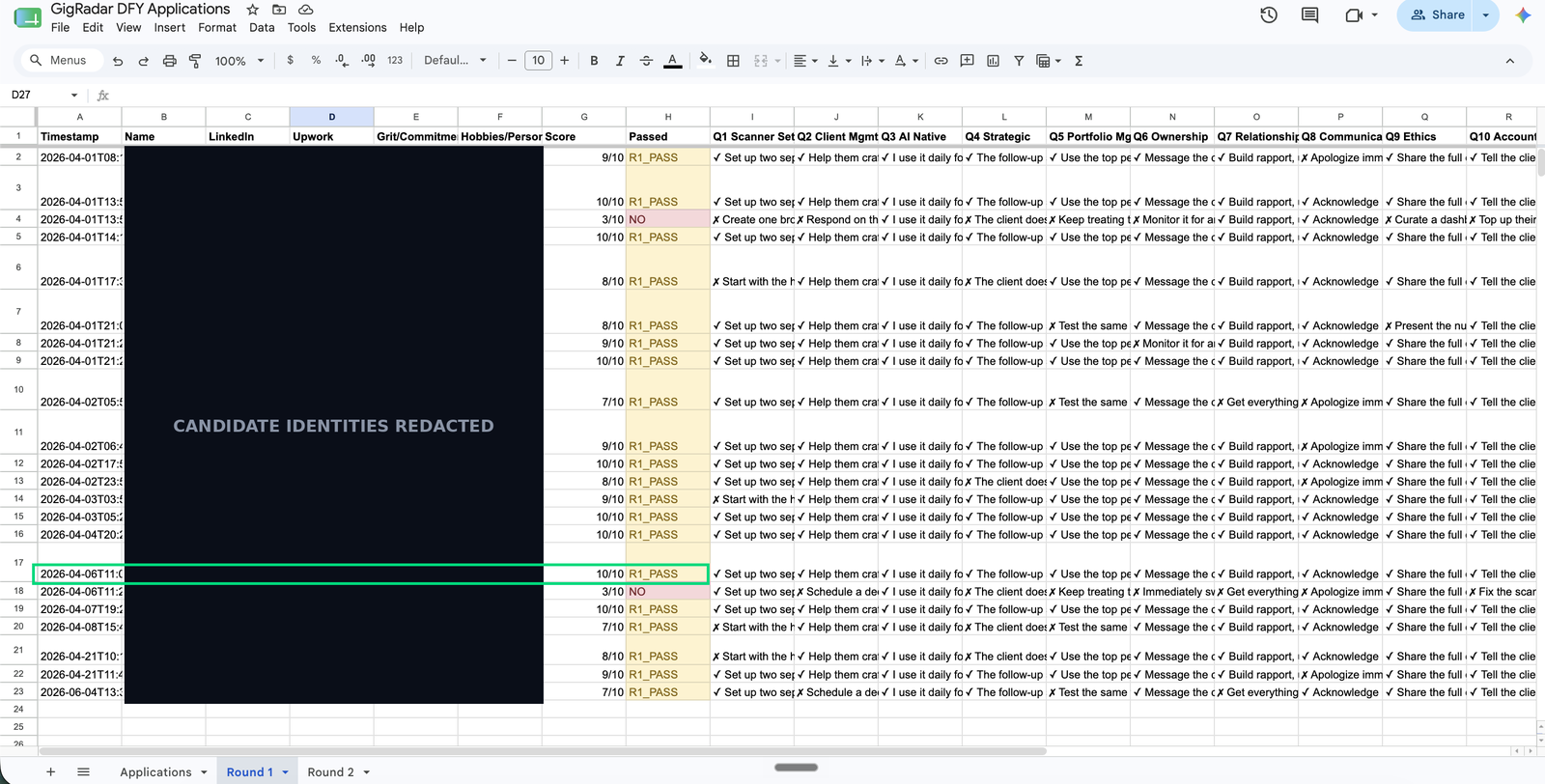
Round 1 — the judgment gate. Every applicant hit a branded role page (dark-themed, with a live income calculator wired to real commission numbers) and took 10 situational questions: how do you respond when a client says "zero replies in 10 days, I'm canceling" — and the data shows three replies they never converted? Auto-scored out of 10, pass bar enforced, every result landing in a ranked sheet.
Round 2 — proof of work. Survivors got three challenges pulled from the actual job: fix a broken keyword-scanner configuration, write the reply to a frustrated client email, and triage a Monday-morning pileup by revenue-at-risk. AI graded each against a rubric; borderline cases were flagged for human review, and every verdict was traceable to a rubric line.
The output: a spreadsheet that ranked the entire pool by demonstrated ability. No resumes were read at any point — there was nothing to read. Applicants either showed judgment or they didn't.
The winner
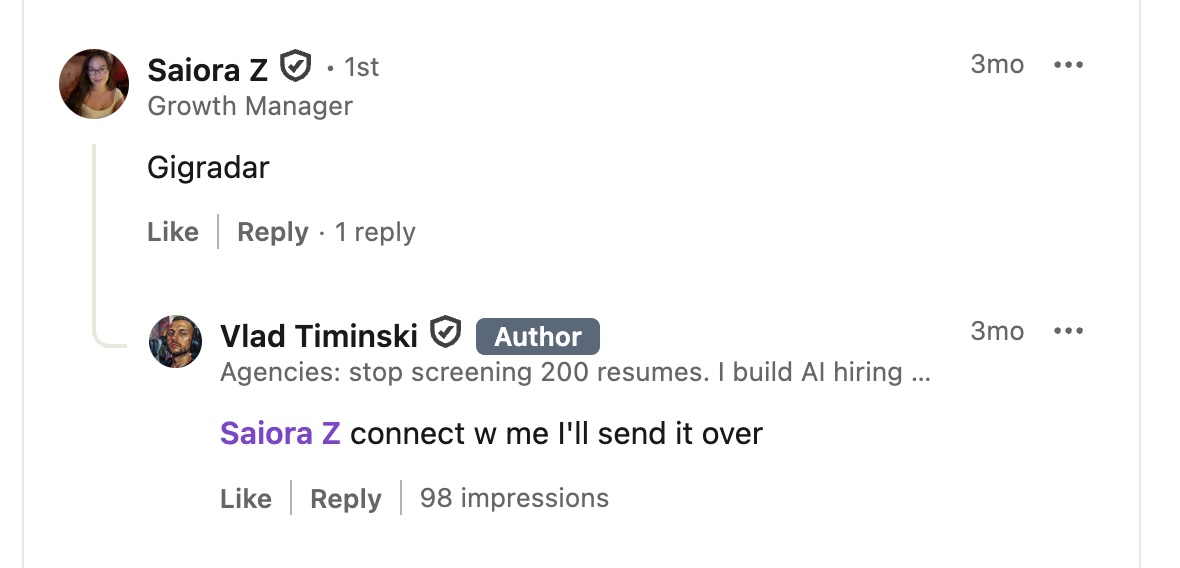
Saiora found the post organically in her feed. Seven years in aviation quality assurance and safety compliance, then a pivot into performance marketing and partner management — on a resume, an unusual path a keyword filter or a tired founder skimming a PDF at 11pm might have passed over.
The funnel didn't care about the path. It cared about the answers: 10/10 on Round 1, top-of-pool scores across the Round 2 challenges. She earned one of just five interviews held across the whole pool — and by design, that conversation was the final round: 49 minutes, mostly spent confirming what the scores already showed and selling her on the vision.
The detail I didn't expect: mid-interview, unprompted, she reviewed the funnel itself —
"It's very different from the old-school stuff you'd see... I really like the design, the layout, the questions. It really catches your eye — especially the calculator at the end."— Saiora, in her final interview, on the hiring process she'd just been through
The screening process that filtered 52 people to one was also the thing that made the winner more excited to join. Serious processes attract serious people.
"But couldn't candidates just use AI on the test?"
Some did — the winner included, and she said so openly. For an AI-native role, that's not cheating; that's the job. The challenges were built so that tools raise the floor but judgment sets the ceiling: AI can polish a sentence, but it can't decide to triage the quiet high-value client over the two loud ones — the pool's answers proved that split just fine. If your role forbids AI, your rubric penalizes it; ours rewarded using it well.
Three months later
When she heard this case study was being written, her reaction — verbatim, from Slack:
"I was surprised indeed you didn't even ask for a resume... People are tired of conventional methods of hiring — rounds of interviews, Easy Apply and nothing. This is a creative approach, eye-catching for candidates, and it filters out people who want the job without putting in the effort. Plus once you complete the tasks, the candidate gets a better idea about the job. I'm totally vouching for this!!"— Saiora, three months into the role
Saiora is a Growth Manager at GigRadar, owning client relationships and — in the founder's own assessment — killing it. Days from application to offer: about one, plus a reference check. Founder hours spent on the entire pool: five conversations with pre-proven candidates, and minutes reviewing a ranked sheet.
Compare that to the default: weeks of resume triage, four-round interview marathons, and a coin-flip on whoever performed best in conversation.
What made it work
- The post did the attracting — honest role, real numbers, personality. Distribution is half the funnel.
- The funnel did the filtering — judgment questions killed the noise; work samples found the signal.
- The founder did only the last mile — one conversation, with someone who'd already proven the job.
- Candidates respected it — fast, fair, transparent, and modern enough that the winner complimented it.
Want this for your open role? MeetTheFive builds the same machine for agencies and B2B teams: branded role page, judgment gate, AI-graded work samples against your rubric, ranked top five booking your calendar directly. Live in 48 hours, $3,000 flat.
Play the 4-minute demo — you're the candidate → or book an intro call